

You know that feeling in your gut during an interview when something feels… off? Maybe the hiring manager checked their phone three times during your conversation. Or everyone you met looked exhausted in a way that coffee couldn’t fix. Perhaps the office was eerily silent for 3 pm on a Tuesday. You brushed it off. The salary was great. The title was impressive. You told yourself you were overthinking it. Then six months later, you’re updating your resume again, wondering how you missed the signs.
I’ve been in this business long enough to have heard countless versions of this story. And here’s what breaks my heart: most of these situations were entirely preventable. The red flags were there from day one; we just haven’t been taught what to look for. Or worse, we’ve been conditioned to ignore them.
“It’s just how things work at this level.” “All fast-growth companies are a bit chaotic.” “Every culture has its quirks.” We’ve all said these things. We’ve all talked ourselves into situations that our gut told us to avoid.
Why This Matters More Than Salary
I’ve watched brilliant professionals, the kind who’ve built departments from scratch, turned around struggling divisions, led teams through impossible odds, and yet they have left roles they loved for impressive salary bumps at companies with glossy websites and ambitious growth plans. The money was incredible, but the culture was toxic.
Within months at a new, ambitious company, their confidence, carefully built over years, begins to erode. The generous compensation can’t offset the environment where targets shift without warning, and mistakes become ammunition rather than learning opportunities.
“But I’ve survived tough environments before,” you might be thinking. “I can handle it.”
Can you, though? And more importantly, should you have to?
Here’s what the data tells us, and it’s striking: toxic culture is the strongest predictor of employee turnover; 10.4 times more influential than compensation when it comes to people leaving their jobs. Ten times more influential than your paycheck!!!
Nearly 60% of workers say they would accept a new job at a lower salary to escape a toxic work environment (iHire). And one in five American employees has left their job in the past five years specifically because of bad company culture, costing businesses $223 billion (Straits Research) in turnover expenses.
For my European colleagues, the story’s remarkably similar. In a 2022 survey of over 16,000 European workers across nine countries, one-third indicated they expected to quit their jobs within three to six months, a staggering turnover rate for a region where people typically value job stability. In Italy alone, nearly 2.2 million resignations were recorded in 2022, while Spain saw about 70,000 workers with permanent contracts resign, more than in any year since 2001 (Wellable).
The toll? According to EU-OSHA’s latest survey, 29% of EU workers suffer from stress, depression, or anxiety, with over 40% reporting severe time pressure and one in three feeling their efforts go unnoticed( iHire). Three in five European workers report feeling burnt out, with 36% at high risk for mental health issues (Wellable).
Here’s the truth nobody wants to say out loud: you can’t put a price tag on your mental health, your self-worth, or your peace of mind. Not even for that VP title. Not even for equity. Not even for the prestige of working at a name-brand company.
The Red Flags You’ve Been Trained to Excuse
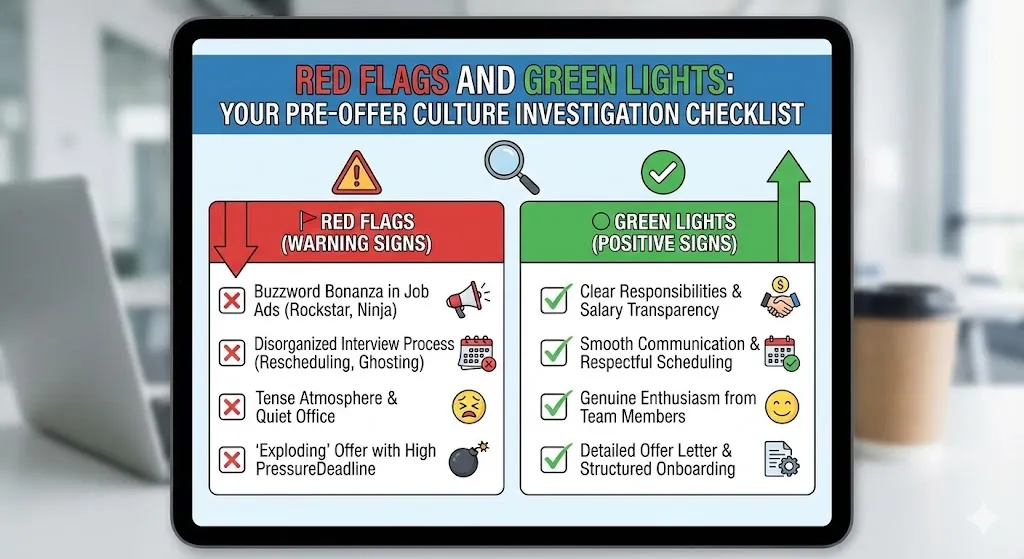
Through hundreds of placement conversations, with everyone from rising directors to experienced C-suite executives, I’ve identified the warning signs that matter most. Some are obvious. Others are more subtle. However, all of them deserve your attention.
During the Interview Process:
Ask about the team and watch what happens. If you get a carefully worded “Well, we’ve had some turnover recently” or “We’re rebuilding the team,” that’s not transparency, that’s more damage control. Ask more questions, such as: “How long did the last three people in this role stay?” If you’re getting vague answers or nobody lasted more than 18 months, you’re not looking at bad luck. You’re looking at a pattern.
Healthy organisations retain talent. If they can’t, there’s a reason. And that reason is about to become your daily reality.
Healthy cultures don’t need platitudes. They’ll tell you specific stories: “Here’s how we handled a recent challenge.” “Last month, we celebrated when one of our junior team members presented a solution that changed our approach.” They show you the culture through evidence, not slogans.
The Communication Matters. Pay close attention to how they treat you during the hiring process. Did they reschedule your interview three times? Do emails go unanswered for days, then suddenly you’re getting urgent requests at 6 pm? Are you being rushed through decisions without adequate time to think? This is not charming startup energy. This is a preview of coming attractions.
The Interview That Feels Like a Test You’re Destined to Fail. There’s a difference between thorough and adversarial. If every interviewer seems more interested in catching you in inconsistencies than understanding your potential, if you feel like you’re constantly defending yourself rather than engaging in a genuine conversation, that’s the culture.
You’ll spend your days in defensive mode rather than doing your best work.
The Green Flags
Not all workplaces are broken. I’ve worked with organisations that genuinely invest in their people, create psychological safety, and build environments where professionals at every level can thrive. Here’s what to look for:
They Don’t Sugarcoat the Challenges. When you ask about what’s not working or what keeps them up at night, healthy organisations lean in. They’ll tell you: “We’re struggling with X right now and here’s what we’re trying.” “This quarter didn’t go as planned because of Y, and we learned Z.”
They trust you with reality because they see you as a future partner in solving problems, not as someone to “sell to” at any cost.
People Actually Light Up Talking About Each Other. Try this in every interview: “Tell me about someone on the team you really enjoy working with.”
In healthy cultures, you’ll see genuine warmth. You’ll hear specific stories about collaboration, moments of support, and times when someone went above and beyond. In toxic cultures? Awkward pause. Diplomatic corporate-speak. Or worse, silence.
Your Tough Questions Are Met with Respect, Not Defensiveness. Ask about work-life balance. Ask about mental health support. Ask how they handle it when someone makes a significant mistake.
Healthy cultures don’t just tolerate these questions; they welcome them. You’ll hear about specific policies, real examples, and honest admissions of where they’re still improving.
They’re Honest About Why People Leave. “Why did the last person in this role move on?”
Organisations that value growth will tell you honestly: “They wanted a different career path and we helped them find it.” “They relocated for family reasons. We offered remote, but it didn’t work for them.” “Honestly, there was a mismatch in expectations, and we learned from it.”
Trust Your Gut (It Knows Things Your Resume Doesn’t)
My piece of advice that I tell every candidate I work with, from first-time managers to seasoned executives, is this:
Data is important. Your research matters. But so does your intuition.
Your nervous system is picking up signals your conscious mind is rationalising away. If you leave the interview feeling drained rather than energised, if your shoulders are tense through the entire conversation, if you’re already making excuses for concerning behaviour, please listen to that.
You wouldn’t ignore a check engine light in your car. Don’t ignore the warning lights in your body.
To the Hiring Managers and Leaders Reading This
I see you nodding along to the “green flags” section, thinking about your own organisation. Maybe you’re realising you’re not showing up as well as you could be in the hiring process. Maybe you’re recognising some of your own team’s challenges. That’s the starting point.
The organisations that win the talent war aren’t the ones with the biggest budgets or the flashiest perks. They’re the ones that create environments where talented people can do their best work without sacrificing their humanity.
Your hiring process is your first impression. Make it count. Be honest about the challenges. Show genuine respect for candidates’ time and questions. Let your team’s authentic culture show, the good and the still-improving.
The right people will choose you for who you actually are, not who you’re pretending to be.
The next time you’re considering an opportunity, whether it’s a lateral move, a step up, or a complete pivot, I want you to remember something:
You’re not just evaluating whether you’re good enough for them.
You’re assessing whether they’re good enough for you.
Your talent, your energy, your creativity, your dedication, your years of experience, these are gifts you’re choosing to share. Choose wisely who receives them.
The desperation we’re told to feel? It’s a lie. Even in uncertain markets, talented professionals who know their value and won’t compromise their well-being. Sometimes those options take longer to find. Sometimes they require patience and strategic thinking. But they exist.
Until then, trust yourself. You know more than you think you do.
Want help navigating these culture conversations? That’s exactly what we do at Oxiom Hub. We don’t just match skills to job descriptions; we match humans to environments where they can genuinely thrive. Whether you’re a candidate looking for your next right-fit role or a leader building a team that will actually stay, let’s talk. Get in touch: OxiomHub Main page — 2026